
On consumption
How we navigate self on social platforms when they are political warfare minefields.

Who would we be without our digital artifacts and footprints?
When I thought about this question, I forgot I created a substack account four years ago. In 2021, I had aspirations to have a blog again—a more adult version of Xanga from 2001, Tumblr from 2009, and Facebook posts from 2013-2017. The evolution of sharing, from intimacy through passed notes to scrolling through the dozens of views on Instagram stories, has always held tension. The tension between wanting to connect and molding how others perceive me.
I wrote years ago about the embarrassment of the desire to blog alongside stills from Studio Ghibli and the mental anguish of a breakup during the first pandemic peak in New York City. But – as a sociologist, I feel equally embarrassed to live out loud Goffman & Burke’s theory of Dramaturgy. Meaning, a way I understand myself is by how I present myself to others. (Even this act of sharing sociological theory is a way for me to present myself as academic, thoughtful, trustworthy, and perhaps even demure)
For some, the presentation of Self comes easily. For me, I lamented how to create an AIM bio so I looked like an enigma with deep friendships and good taste in punk music. (Dear reader, those friendships endured, but the music is still to be determined)
The algorithm changed how we perceive and present Ourselves. I’m not going to go into 20 years of history, from Facebook statuses to 140 characters on Twitter to Instagram stories to the rise of vertical video as the most popular medium. We know our motivations for using each platform and what we get from them1.
There is a quiet contract we sign when we consume and create on social media. We understand that there may be some underlying gain. An influencer may gain monetary funds through others interacting with their content. As a pleb, I hope to achieve social clout or stronger weak social ties2 with others through my relatable, emotionally vulnerable, or humorous posts.
Prior to January 19, 2025, we had a silent agreement with the influencers, advertisers, and platform developers. We knew they were gaining money from us from advertisers, affiliate links, and views to their pages. We knew that the feeds were not chronological; thus, they were analyzing us and our deepest morbid curiosities, our embarrassing aspirations, our current hobbies.
The Internet is a democracy. Anyone can go viral. Any voice can shout into the void, and sometimes the void responds.
We all know what happened in the United States on January 19, 2025 - TikTok was banned.
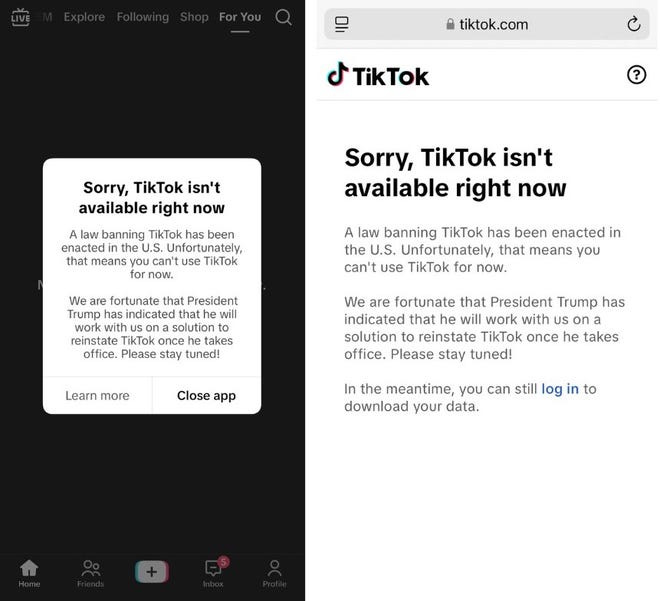
And although it’s been more than a month since the 13-and-a-half-hour TikTok shutdown, our contract with the social media companies has shattered.
We thought there was a contract. There was never a contract between the people and the mediums.
We all lied. Practically no one has actually read the terms and conditions we all agree to when we sign up for a social networking site. And, we are not in control of the sites we frequent.
We know they are lying, they know they are lying, they know we know they are lying, we know they know we know they are lying, but they are still lying. That is the feeling that you're having right now, which is that everyone involved knows that there's a lie playing out on a societal level.
Aleksandr Isayevich Solzhenitsyn, Russian/Soviet political dissident of the Russian prison system
Alexei Yurchek, an anthropology professor from Russia, coined the term HyperNormalization3. As Adam Curtis4 beautifully defined Hypernormalization, “Everyone [knows] it was fake, but because no one had any alternative vision for a different kind of society, they just accepted this sense of total fakeness as normal.”
But what does hypernormalization mean for us and social networking sites? (Aside from “a lot”) Our speech, connections, and communities have never been free. As Carlota Fay Schoolman and Richard Serra stated in their 1973 short film Television Delivers People5, “you are the product.”

But by banning and reinstating TikTok we were first censored, and then threatened.
Of course there’s the threat that it could leave again - but that’s not the true threat. It’s the threat that we don’t know, what we don’t know.
We no longer know what is being censored. Taylor Lorenz stated on the podcast Close All Tabs6, “The effect that that ban has had, even though it’s been temporarily reinstated… tons of people deleted the app.” She reported in late January the trend7 of “cute winter boots” to prevent censorship. Activists, journalists, artists, pundits, etc have long expressed their accounts being shadow-banned8. In the same interview, Lorenz explains how TikTok was the last place for progressive conversation since Elon’s takeover of Twitter in October 2022.
The thing is: all spaces are now politicized. We have no place to shut off. Each choice we make is participating in a political discourse, whether we want it to be or not. Social networking sites used to feel like a democracy in which each voice could be heard, or not heard. Viral or ephemera. Now, whether it is or not, simply because it feels like each site is owned by the state… the vibe is bad, man.
We used to have a choice in feeling bad. Comparison to others. Addiction to the endless feed. Hate-following.
And now?
Now there is no trust. Social networking sites, as chaotic and “toxic” as they can be (and indeed they can lead to real-life deathly consequences9), were, in fact, a place of real connection. There are, of course, relationships and deepening ties through the messaging functionality of the apps or connecting to brands and topics of interest. Then there’s the safety it provides for so many queer youths10.
One might say, “Who cares if social networking sites don’t feel good anymore? Go touch grass and hang out in person.” But the Internet is meant to connect. And the Internet feels synonymous with social networking sites. Each site has some form of connection with others - from reviews to comments to an activity feed. Gen Z replaced Google Search with TikTok. Instagram is our photo album and messaging platform. Reddit is our instruction manual/faq. Moreover, bringing back Goffman and Burke, if we learn Self by presentation to others, each space we engage in becomes a part of us.
We shouldn’t have to abandon our platforms and the communities we’ve joined.
But the vibes are bad, man. Our contracts feel shredded into the wind. And if we’re the product, maybe we can withhold to change the supply. Maybe that means continuing to find ways to work around censorship. Innovate the way we use platforms. Find new ad blockers. Join open-source AT protocols like Bluesky or Mastodon. Make all our profiles private. Do something where we drive up the price of our product.
Or maybe we resort back to letter writing and calling cards. Make some physical artifacts. Eat the technocrat oligarchs.
Alhabash, Saleem, and Mengyan Ma. "A Tale of Four Platforms: Motivations and Uses of Facebook, Twitter, Instagram, and Snapchat Among College Students?" Social Media + Society, 2017, https://doi.org/10.1177/2056305117691544. Accessed 25 Feb. 2025.
https://news.stanford.edu/stories/2023/07/strength-weak-ties
Yurchak, Alexei. Everything Was Forever, Until It Was No More: The Last Soviet Generation. Princeton University Press, 2005. JSTOR, http://www.jstor.org/stable/j.ctt3fgx18. Accessed 27 Feb. 2025.
Curtis, Adam. “Adbusters Media Foundation | Journal of the Mental Environment.” Www.adbusters.org, www.adbusters.org. Accessed 26 Feb. 2025.
KunstSpektrum. “Richard Serra “Television Delivers People” (1973).” YouTube, 3 Feb. 2011, www.youtube.com/watch?v=LvZYwaQlJsg.
Sung, Morgan, et al. “TikTok’s VIbe Shift.” Kqed.org, 26 Feb. 2025, www.kqed.org/news/12028629/tiktoks-vibe-shift. Accessed 26 Feb. 2025.
Lorenz, Taylor. “TikTok’s “Cute Winter Boots” Meaning Explained.” Usermag.co, User Mag, 25 Jan. 2025, www.usermag.co/p/tiktok-cute-winter-boots-meaning-explained-algospeak. Accessed 26 Feb. 2025.
“Shadow Banning.” Wikipedia, 4 Apr. 2021, en.wikipedia.org/wiki/Shadow_banning. Accessed 26 Feb. 2025.
Wikipedia Contributors. “2014 Isla Vista Killings.” Wikipedia, Wikimedia Foundation, 7 Dec. 2019, en.wikipedia.org/wiki/2014_Isla_Vista_killings. Accessed 26 Feb. 2025.
Robards, Brady, et al. “Tumblr as a Space of Learning, Connecting, and Identity Formation for LGBTIQ+Young People.” A Tumblr Book: Platform and Cultures, edited by Allison McCracken et al., University of Michigan Press, 2020, pp. 281–92. JSTOR, http://www.jstor.org/stable/10.3998/mpub.11537055.35. Accessed 25 Feb. 2025.
dang the soltzhenitsyn quote 🫡
Well done, man😇